
The First FDA-Licensed Freeze-Dried Plasma in the U.S.: What EZPLAZ Actually Changes
On July 29, 2026 the FDA licensed EZPLAZ — the first freeze-dried plasma ever licensed in the U.S. What's actually in the box, how the stability and clinical data read honestly, and where a room-temperature plasma fits in the TCCC and TECC resuscitation sequence.
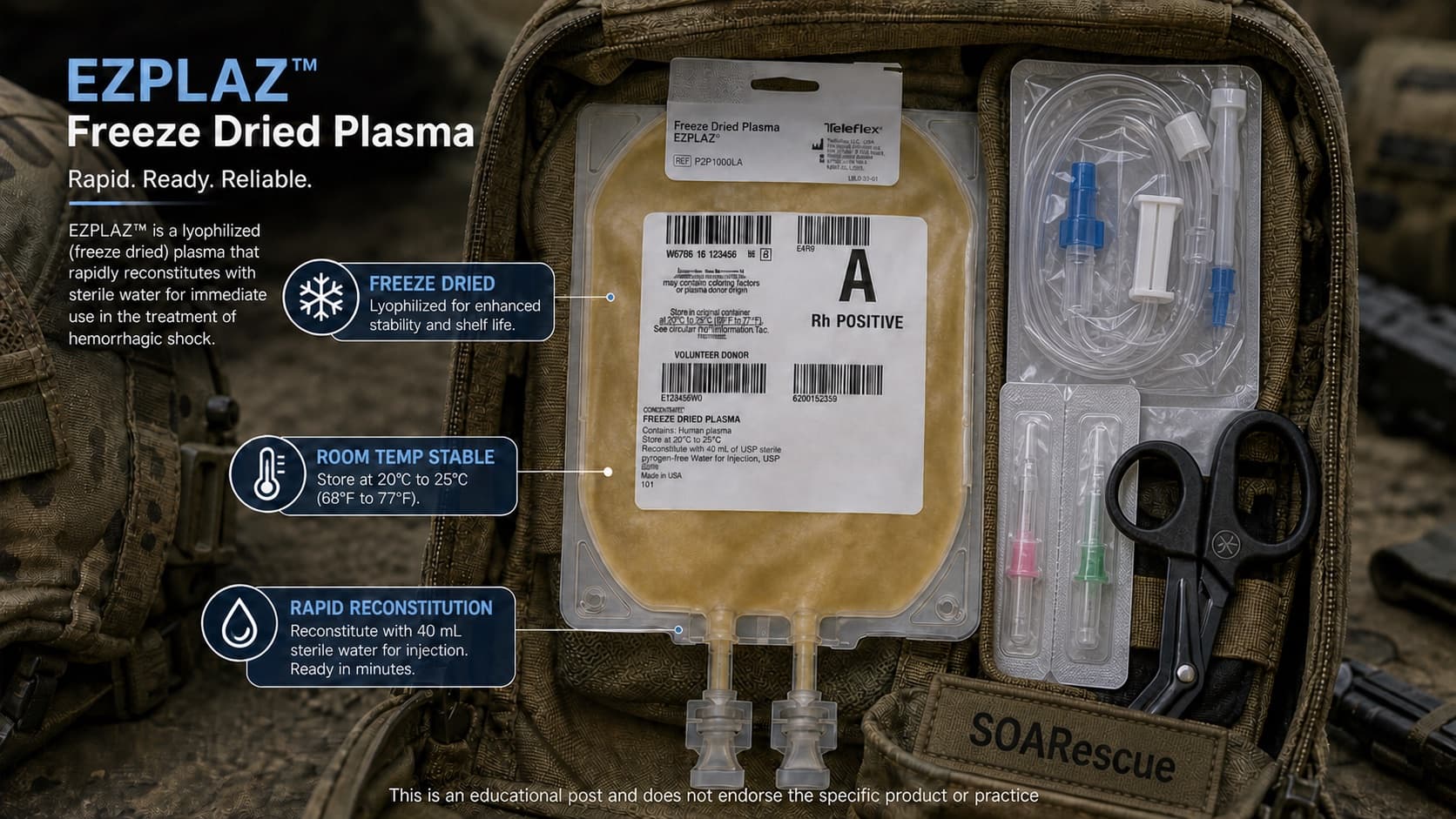
On July 29, 2026, the FDA licensed EZPLAZ Freeze Dried Plasma, manufactured by Vascular Solutions LLC, a Teleflex subsidiary. It is the first freeze-dried plasma product ever licensed in the United States, and it closes a gap that operational medicine has been working around for more than a decade.
The gap was never conceptual. Plasma-first resuscitation has been the direction of travel in trauma care for years. The problem was physical: frozen plasma needs a freezer, a thaw cycle, and a cold chain that does not exist on a ridgeline, in the back of a rotor-wing aircraft, or in a county ninety minutes from the nearest trauma center. A shelf-stable product removes the freezer from the equation. Until this week, no such product had a U.S. license.
What came before
U.S. forces have been using freeze-dried plasma, just not American freeze-dried plasma. On July 9, 2018, the FDA granted the Department of Defense an Emergency Use Authorization for the French-manufactured product. That authorization worked, but it came with hard ceilings: the Military Health System's own description notes the EUA applied only to the French product, which "significantly limits the amount of product available," and that supply volume plus the training and regulatory compliance burden constrained how widely DoD could push it across the services.
The domestic effort started earlier. In April 2014, Vascular Solutions entered a Cooperative Research and Development Agreement with the Defense Health Agency's Warfighter Protection and Acute Care program specifically to produce an FDA-approved, commercially available U.S. source. Development ran under Public Law 115-92, the 2017 statute authorizing expedited DoD-FDA collaboration on products addressing conditions that affect service members. Twelve years from CRADA to license.
The distinction between an EUA and a biologics license matters. A license means EZPLAZ is a commercially available, prescription blood component with a manufacturer's Circular of Information — not a controlled-access investigational product with case report forms attached to every unit.
What is actually in the box
Each unit is lyophilized from approximately 270 mL of fresh frozen plasma collected from a single male volunteer donor at a U.S. licensed blood center. The kit ships with the FDP unit, a 250 mL bag of sterile water for injection, a fluid transfer set, and a blood transfusion set containing a 170-micron filter. Reconstitution runs one to two and a half minutes of gentle circular agitation; if the powder has not dissolved by 2.5 minutes, the unit gets discarded. Reconstituted volume is equivalent to 270 mL of plasma, and it must be infused within four hours. IV or IO administration are both on-label. The kit stores at 2 to 25°C (36 to 77°F) for a 12-month shelf life, in a flexible plastic bag rather than the glass bottles used by earlier freeze-dried plasma products — a meaningful difference for anyone who has managed glass in a jump kit or an aircraft.
EZPLAZ is supplied as group AB or group A with a low anti-B titer (under 1:200 by saline tube method), and the labeling permits either group to be given in emergency treatment of hemorrhage or coagulopathy before the recipient's ABO group is known. To reduce TRALI risk, every unit comes from a male donor, whose plasma is less likely to carry anti-HLA antibodies.
The data, read honestly
The prescribing information includes stability tables that deserve attention, because they show storage temperature is not a neutral choice.
Held at 4°C for 12 months, factor retention stays close to source plasma: Factor II down 8% versus FFP, Factor V down 10%, fibrinogen down 6%, Factor VIII down 22%. Held at 25°C for the same 12 months, the losses widen — Factor V down 29%, Factor VIII down 39%, fibrinogen down 21% (352 mg/dL in FFP to 277 mg/dL), Protein S down 31%, von Willebrand factor activity down 40%. An additional Factor VIII decline of up to 12% has been observed across the four-hour post-reconstitution window.
Room-temperature storage is what makes the product operationally useful. The tables show what it costs. Agencies with the option to refrigerate are buying back a substantial share of factor activity by doing so.
On clinical evidence, the labeling is direct: the clinical study was a Phase 1 safety and tolerability dose escalation in 24 healthy adults receiving roughly 270, 540, or 810 mL. Nine of 24 subjects had a treatment-emergent adverse event, 17 events total, 16 mild and one moderate. None were considered related to EZPLAZ. There were no serious adverse events, no deaths, and no clinically significant safety or laboratory signals. That is a clean safety picture — and it is not an efficacy trial. There is no randomized outcome data for this product.
The efficacy argument rests elsewhere, and the manufacturer cites it directly: reference one in the prescribing information is Sperry et al., the PAMPer trial (NEJM, 2018), which randomized 501 trauma patients at risk for hemorrhagic shock during air medical transport and found 30-day mortality of 23.2% with two units of prehospital thawed plasma versus 33.0% with standard care — a 9.8 percentage point absolute reduction. PAMPer studied thawed plasma. The inference that a reconstituted product delivering the same protein array performs comparably is reasonable, and it is still an inference.
Where it fits in TCCC and TECC
The 1 May 2026 TCCC Guidelines list resuscitation fluids for hemorrhagic shock in this order: cold stored low titer O whole blood; pre-screened low titer O fresh whole blood; plasma, RBCs and platelets in a 1:1:1 ratio; plasma and RBCs 1:1; then plasma or RBCs alone. Under an approved command or theater blood product protocol, the guidelines place "reconstituted dried plasma, liquid plasma or thawed plasma alone" at the bottom of that sequence, when nothing above it is available.
The TECC BLS/ALS Guidelines (2025) frame it similarly for the civilian side — blood products for suspected hemorrhagic shock where there is appropriate training, provider scope of practice, and an approved medical protocol, resuscitating with plasma and PRBCs 1:1 or fresh whole blood through a warmer.
The EZPLAZ indication mirrors that placement almost word for word: transfusion in adults "when plasma is required and other plasma products are not available." This is not a whole blood replacement. It is what you carry when whole blood is not on the vehicle.
Limitations worth knowing before you write a protocol
It carries no red cell mass and no platelets, so it does nothing for oxygen carrying capacity. The labeling states it is not intended for routine volume expansion, and that transfusion may not meaningfully correct a minimally elevated INR in the 1.5 to 1.7 range. It may be less effective than targeted therapy where one exists — vitamin K or specific reversal agents for anticoagulation, fibrinogen concentrate for hypofibrinogenemia. It is contraindicated in IgA deficiency and in patients with prior hypersensitivity to plasma or plasma-derived products, and safety and effectiveness in pediatric patients have not been established. The collection process does not use pathogen reduction technology, and because the product is human plasma it carries the standard infectious risk language, including theoretical vCJD transmission.
One operational detail is easy to miss: nothing may be added to EZPLAZ or run through the same tubing simultaneously except 0.9% sodium chloride. Lactated Ringer's and other calcium-containing solutions must never share a line with a citrated blood component. Given that TCCC calls for a gram of calcium after the first transfused product, that is a line-management problem to solve on paper before it becomes one at 0300.
What comes next
The Joint Trauma System's Dried Plasma CPG, dated 09 June 2026, covers French FDP and octaplasLG Powder. It predates this licensure by seven weeks and does not address EZPLAZ. An update is the obvious next step, and it will be the document that tells the military side how this product is meant to be used rather than simply what it is.
On the civilian side, adoption runs through the same channels every prehospital blood program does: state scope of practice, medical direction, transfusion service agreements, storage and tracking, and reaction reporting. Teleflex has not published pricing or a distribution timeline. Neither TCCC nor TECC currently names EZPLAZ specifically, and whether either committee adds product-level language is worth watching.
The honest summary is that a real logistical barrier has been removed and the clinical questions remain open. A product that sits at room temperature for a year, ships in a bag instead of a bottle, and is ready to run in under three minutes solves a problem the trauma community has complained about for twenty years. Whether it changes outcomes in the environments it was built for will be answered by post-licensure data that does not exist yet.
Sources: EZPLAZ Prescribing Information (Rev J, 07/2026) and Circular of Information, Vascular Solutions LLC; FDA press announcement, July 29, 2026; Teleflex investor release, July 29, 2026; AABB Regulatory Update, July 29, 2026; TCCC Guidelines, 01 May 2026; TECC Guidelines for BLS/ALS Clinicians, 2025; JTS Dried Plasma CPG (ID103), 09 June 2026; Military Health System, French Freeze-Dried Plasma Use in the DoD; Sperry JL et al., N Engl J Med 2018;379:315-326.