
TCCC 2026: The Drug Box Changed More Than the Algorithm
The 1 May 2026 TCCC Guidelines don't restructure the algorithm — they rewrite the drug box. Fentanyl is out, two antibiotics swapped, suzetrigine and intranasal esketamine are in, and the TBI targets tightened. A change-by-change read on what each one actually costs in procurement, protocol, and training.
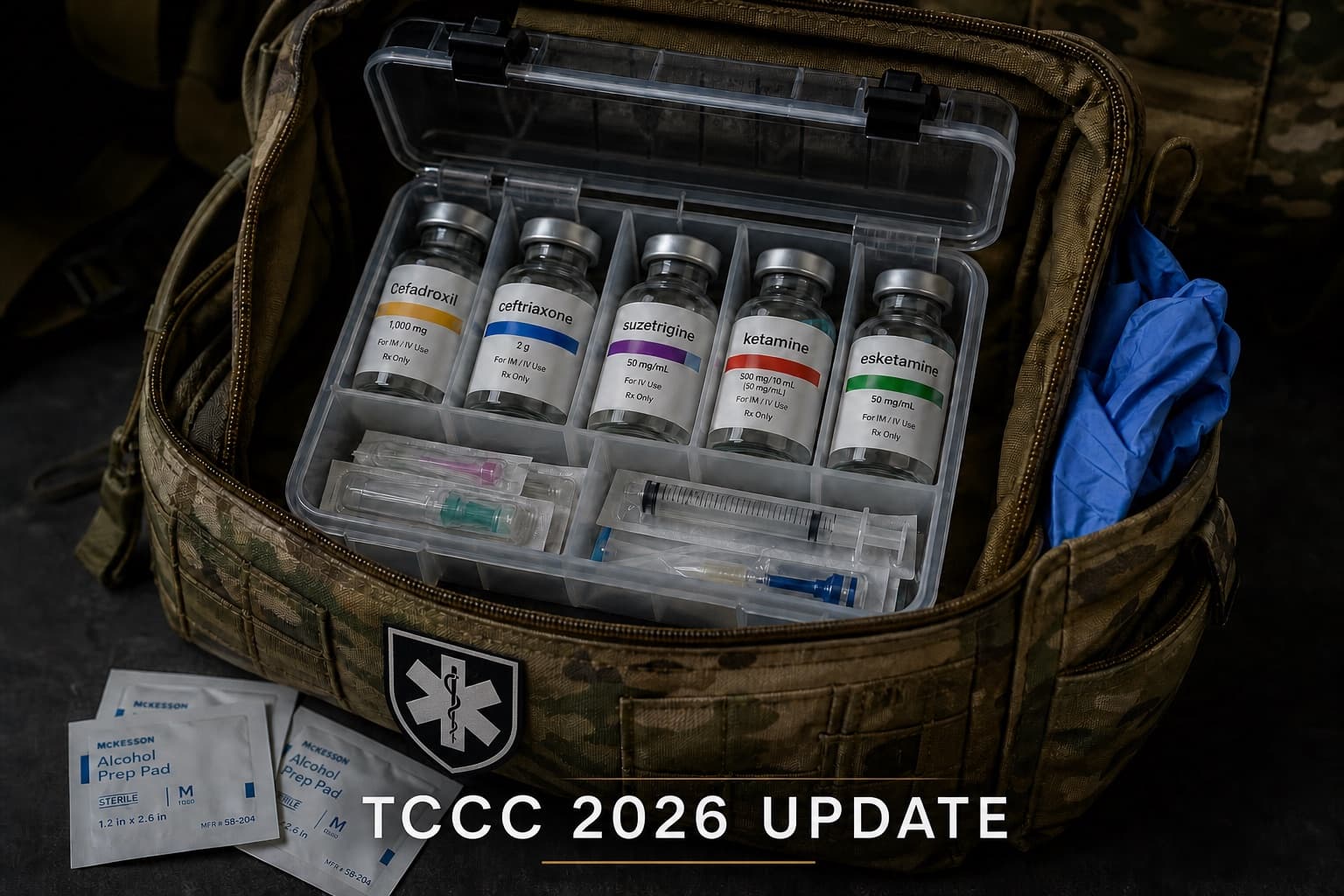
The 1 May 2026 TCCC Guidelines are a focused update, not a rewrite. Care Under Fire is essentially untouched. The Tactical Field Care sequence runs in the same order it has for years. If you were expecting a restructured algorithm, you will not find one.
What changed is most of what you carry. Two antibiotics were replaced. Fentanyl left the analgesia section entirely. Two drugs that were not in TCCC before — one of them approved by the FDA about fifteen months before these guidelines published — are now in it. The TBI targets were tightened and given a definition to hang on. That lands on logistics, procurement, and training rather than on muscle memory.
Analgesia was rebuilt, not adjusted
The 2024 section branched on shock status. Option 2 — oral transmucosal fentanyl citrate 800 mcg, or fentanyl 50 mcg IV/IO or 100 mcg IN from a paramedic — was available only if the casualty was not in shock or respiratory distress and not at significant risk of either. Ketamine was the answer when they were.
The 2026 section drops that branch. Options are organized by whether the casualty can stay in the fight, and the stated goal is sharpened: tolerable pain that preserves airway patency, respiratory drive, and mentation, rather than complete pain elimination or total sedation. Fentanyl and OTFC do not appear anywhere in it.
For a casualty who can stay in the fight, the Combat Wound Medication Pack now holds acetaminophen 1,000–1,300 mg PO every 8 hours, meloxicam 15 mg PO daily, and suzetrigine 100 mg PO once followed by 50 mg every 12 hours. For a casualty who cannot, and in the hands of TCCC medical personnel, the options are ketamine 100 mg IM, 50 mg IN, or 25 mg (or 0.2–0.3 mg/kg) IV/IO over one minute; esketamine 14 or 28 mg IN, repeatable every 30 minutes as needed; and ondansetron 4 mg for nausea.
Ketamine deserves a small note. The 2024 doses were printed as ranges — 20–30 mg IV/IO, 50–100 mg IM or IN, each with a mg/kg equivalent in parentheses. The 2026 entries collapse those to single numbers that sit inside the old ranges, and only the IV/IO line keeps a weight-based option. This is not a potency change. It is one less decision to make.
Suzetrigine: what it is, and what the data actually shows
Suzetrigine (Journavx) was approved by the FDA on January 30, 2025 for moderate-to-severe acute pain in adults. It is a selective Nav1.8 voltage-gated sodium channel blocker. Nav1.8 is expressed almost exclusively in peripheral pain-sensing neurons, so the drug interrupts the signal before it reaches the central nervous system. No opioid receptor activity, no respiratory depression, no demonstrated addiction or dependence in human or animal studies, and it is not a scheduled substance — which is the entire reason it is attractive on a battlefield and in a controlled-substance-averse EMS system.
The efficacy picture is more modest than the mechanism suggests. In the two pivotal trials, suzetrigine beat placebo. Against hydrocodone/acetaminophen it was comparable in one and significantly worse in the other — not superior in either. The Medical Letter's review notes the data come from 48-hour trials only and positions the drug behind NSAIDs as first-line. Cost is real: roughly $232.50 for a seven-day supply.
None of that makes it a bad addition. A non-opioid with no respiratory depression, sitting in a pack that can be self- or buddy-administered, has obvious value where the alternative was a Schedule II lozenge. But "as good as an opioid" is not what the trials showed.
Esketamine intranasal: the one to read carefully
Esketamine IN is needle-free and preserves airway reflexes at analgesic doses. It is also the entry most likely to create a problem for someone who does not read past the drug name.
There is no FDA-approved product labeling for intranasal esketamine as an analgesic. SPRAVATO, the approved intranasal esketamine in the U.S., is indicated for treatment-resistant depression and for depressive symptoms in major depressive disorder with acute suicidal ideation. It is a Schedule III controlled substance available only through a restricted REMS program because of sedation, dissociation, respiratory depression, and abuse risk. Its own label states it is not approved as an anesthetic agent.
TCCC's 14 or 28 mg IN is therefore off-label use of a REMS-restricted controlled substance. That is not disqualifying — off-label use is routine and often correct — but it is a procurement and medical direction conversation before it is a clinical one, and it will land differently in a military supply chain than in a county EMS system.
Antibiotics: fluoroquinolone and carbapenem out, cephalosporins in
Section 12 now recommends antibiotics for all open combat wounds and invasive procedures, an expansion from the 2024 wording. The regimen changed completely.
| 2024 | 2026 | |
|---|---|---|
| Oral | Moxifloxacin 400 mg PO daily | Cefadroxil 1 g PO once a day (preferred), or cephalexin 500 mg PO every 6 hours |
| Unable to take PO | Ertapenem 1 g IV/IO/IM daily | Ceftriaxone 2 g IV/IO/IM once a day |
The clinical case for the swap is straightforward. Moxifloxacin carries a class warning profile — tendinopathy, neuropathy, CNS effects — that is hard to justify for routine prophylaxis. Using a carbapenem like ertapenem for prophylaxis is exactly what antimicrobial stewardship programs exist to prevent. Cephalosporins give reliable gram-positive coverage against the organisms that actually contaminate combat wounds, and ceftriaxone adds gram-negative breadth with once-daily IM dosing that works in the field.
Penetrating eye trauma changed in step: section 9 now calls for ceftriaxone 2 g IV or IM, or cefadroxil 1 g orally, as soon as possible.
One operational detail. Ceftriaxone and calcium-containing solutions precipitate. The absolute contraindication applies to neonates, where fatal precipitates have occurred, so it is not the emergency most people assume for adult casualties — but in patients over 28 days the labeling still requires lines be thoroughly flushed with a compatible fluid between infusions. Given that TCCC calls for a gram of calcium after the first transfused blood product, and that Lactated Ringer's contains calcium, that belongs in a protocol rather than being discovered mid-resuscitation.
The TBI section got tighter
This is the quietest significant change. The 2024 guidelines already carried targets — SpO₂ above 90–95%, systolic 100–110 mmHg, a 1–2 L crystalloid bolus. What 2026 adds is a definition and a set of revised, narrower numbers.
Moderate or severe TBI is now defined by threshold: unable to follow simple instructions — thumbs up, two fingers, blink — beyond 10 minutes post-injury, with suspected head injury and no alternative cause.
From there, oxygen saturation goal becomes at or above 92%. The blood pressure target becomes greater than 100 mmHg, dropping the upper bound of the old 100–110 window. If ventilating with capnography, target EtCO₂ 35–45 mmHg; without it, low tidal volume at 10 breaths per minute. For isolated TBI with no evidence of hemorrhage, the crystalloid bolus is replaced by 1–2 units of plasma. Evacuate to neurosurgical capability as soon as possible, with outcomes improved by surgery within 5 hours of injury.
Herniation management is carried forward unchanged — 250 mL of 3% or 5% hypertonic saline, or 30 mL of 23.4%, IV/IO over at least 10 minutes, repeatable once at 20 minutes. What is genuinely new is penetrating TBI, which now gets real guidance and is explicitly not automatically expectant: dress the surface, hemostatic gauze for active bleeding, do not pack the cavity.
Tourniquets: reposition, don't replace
The reassessment instruction itself is unchanged from 2024: expose the wound and determine whether a tourniquet is needed. What changed is the method that follows. If a limb tourniquet was placed over the uniform, reposition it by applying a second one directly to the skin 2–3 inches above the bleeding site, confirm control, then loosen the first. Simply replacing the original is superseded.
Conversion criteria are also unchanged — not in shock, wound can be monitored, not controlling an amputation — and the 2-hour and 6-hour limits still stand. What is new is a limit on who. ASM and CLS trained personnel should not attempt conversion beyond 2 hours post-application unless directed by CMC/CPP or other advanced medical personnel. Read it as written: this is a restriction on junior providers, not a new expectation placed on them. It reflects reperfusion injury, clot destabilization, and rebleeding risk in prolonged evacuation, and it is the kind of guardrail that matters most when evacuation stretches and the most junior person present is the only person present.
Triage guidance also moved out of the main document and now points to Supplement A — Triage in TCCC.
What this actually costs you
The clinical logic is defensible throughout. The friction is downstream. Combat Wound Medication Packs have to be repacked around a drug that runs roughly $33 a day. Esketamine requires answering a REMS and off-label question before it reaches a kit. Ceftriaxone brings a line-flush requirement that ertapenem did not. Each change needs protocol language, a training block, and a medical director's signature before it means anything on a call.
For civilian EMS the gap is wider — these drugs are not on most agency protocols, and TCCC adopting them does not change that. What TCCC does provide is a documented argument for moving away from field fentanyl, and that argument is portable even where the drugs are not.
Sources: TCCC Guidelines, 01 May 2026 (CoTCCC); TCCC Guidelines, 25 January 2024 (CoTCCC); Deaton TG, Montgomery HR, Butler FK. Tactical Combat Casualty Care (TCCC) Guidelines: 1 May 2026 Updates. J Spec Oper Med. 2026;26(2):89-95; Vertex Pharmaceuticals, FDA approval announcement for JOURNAVX (suzetrigine), January 30, 2025; The Medical Letter on Drugs and Therapeutics, suzetrigine review; SPRAVATO (esketamine) nasal spray prescribing information, FDA; Lactated Ringer's Injection prescribing information, DailyMed.