
The Placard Is Not a Capability Statement: Trauma Center Levels and the Destination Decision
\"Highest level of care, fastest\" is a slogan, not a plan. What ACS trauma-center levels actually require, where the measured Level I advantage really is (head injury, not shock), what police and private-vehicle transport do to survival, and a six-question destination framework for when you are the transport asset.
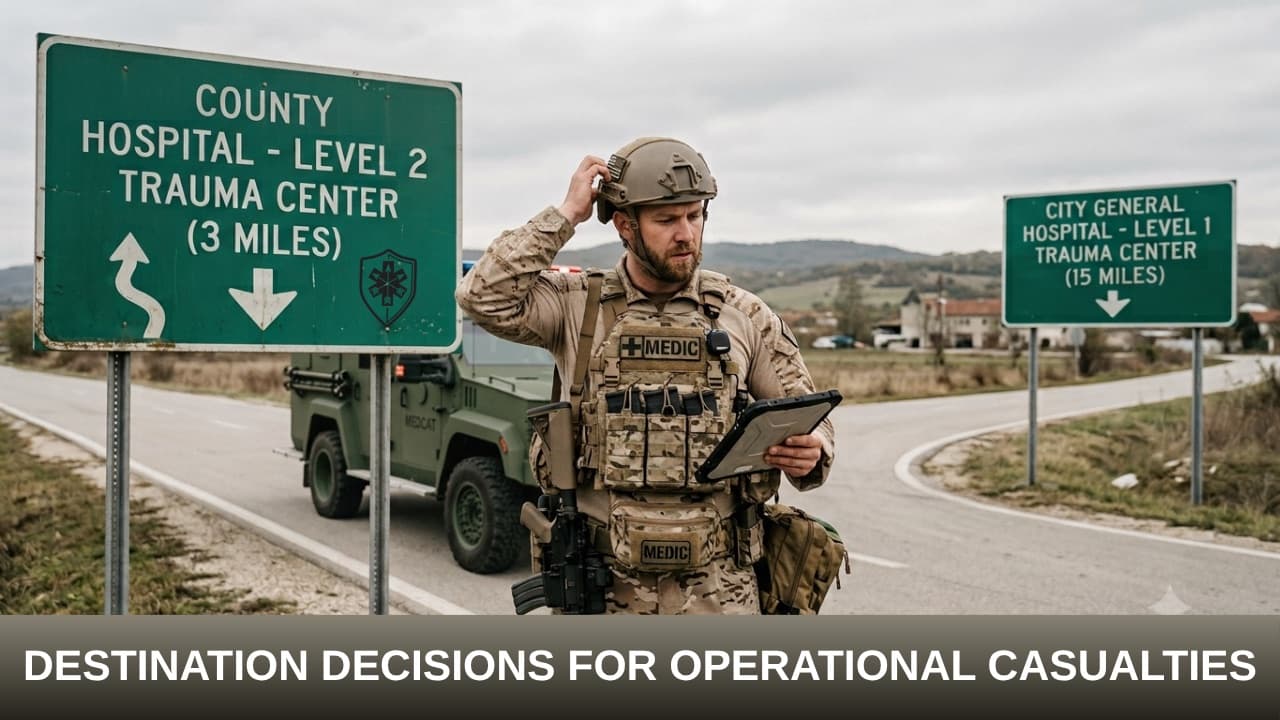
You have a casualty in the back of a vehicle that was not built to carry one. The nearest Level III is eight minutes out. The Level I is twenty-six. You are the only provider, you have what is on your body, and the decision you make in the next fifteen seconds is the one that matters.
Most of the training that gets pushed at tactical and law enforcement medics answers this with a slogan: highest level of care, fastest. That is not wrong so much as it is empty. It assumes the number on the building maps cleanly onto what will happen to your patient in the first hour, and it assumes the drive is free. Neither assumption survives contact with the actual standards.
This is a look at what the levels really mean, what the evidence says the difference is worth, and how to think about it when you are the transport asset.
What actually separates a Level I from a Level II
The governing document is Resources for Optimal Care of the Injured Patient: 2022 Standards — the seventh edition, released March 2022 and revised three times since, most recently July 2025. It is roughly 110 standards. Between Level I and Level II, eight of them differ.
Six apply to Level I and not Level II: research support (1.2), the adult volume floor (2.4), soft tissue and microvascular coverage expertise (4.23), craniofacial expertise (4.24), general surgery resident education (8.4), and research and scholarly activities (9.1).
Two run the other direction — required at Level II and not Level I: specialized orthopaedic trauma care (4.12) and intensivist staffing (4.18). That is not a typo. The fellowship-trained orthopaedic traumatologist is a Level II standard, and it can be satisfied with a transfer protocol rather than a person.
Everything a bleeding patient touches in the first hour is identical between the two. Operating room availability within 15 minutes (3.1). Blood products (3.4). Neurotrauma care (4.10). Interventional radiology (4.15). ICU clinician at the bedside within 15 minutes (4.17). Vascular and cardiothoracic surgery (4.21). Surgeon at the bedside within 15 minutes (5.4). Massive transfusion protocol (5.8). Neurosurgical evaluation within 30 minutes (5.17). No Chapter 3 facility standard differs between Level I and Level II at all.
Strip out research, residency, and the requirement that a Level I care for at least 1,200 trauma patients a year — or at least 240 with an ISS above 15 — and the clinical delta comes down to soft tissue coverage, craniofacial reconstruction, and a resident program. Those are real capabilities. They are not what kills your patient in the first sixty minutes.
Three things about response time that change how you read the standard
The 15-minute clock is measured from patient arrival, not from your radio call. Standard 5.4: "For the highest level of activation, at least 80 percent of the time, the trauma surgeon must be at the patient's bedside within 15 minutes (Level I or II trauma centers) or 30 minutes (Level III trauma centers) of patient arrival." Your notification does not start it. There is one official carve-out — if a patient arrives by private vehicle and is upgraded to highest-level activation after arrival, ACS guidance says the clock starts at activation. Which is precisely the scenario a police-transported casualty creates.
Eighty percent is the bar. A fully compliant Level I misses the 15-minute mark on one in five of its sickest patients and stays verified. That is by design — the standard is a system metric, not a promise about your patient.
The 2022 Standards do not require an in-house attending trauma surgeon at any level. Standard 4.2 says trauma surgery coverage "must be continuously available," defined as 24/7/365 with no gaps, and at Level I and II the surgeon must be dedicated to a single trauma center while on call. That is it. The 2014 Orange Book had called 24-hour in-house attending availability "the most direct method" of providing surgeon involvement. The 2022 standards replaced presence with a response-time metric. A Level I surgeon on home call twelve minutes from the hospital is compliant.
If your mental model of "Level I" is a surgeon standing in the trauma bay at 0300 waiting for you, correct it.
The placard is a legal claim, not a capability claim
ACS verification is a voluntary, fee-based peer review, valid three years. ACS has no regulatory authority and does not designate anything. State designation is the legal act — the state grants the title, writes or borrows the criteria, and decides how many centers exist.
The gap between those two processes is not academic.
Pennsylvania does not use ACS at all. The Pennsylvania Trauma Systems Foundation, an independent accreditor recognized under the state EMS Act, applies a shared 600-patient volume floor to both Level I and Level II, requires the full trauma team within 15 minutes rather than just the surgeon, and requires fellowship training for the trauma program medical director at both levels. Michigan runs an ACS pathway for Level I and II but writes its own Level III and IV criteria, with state-specific critical deficiencies layered on top. Wisconsin still requires red cells and plasma available within 15 minutes at its Level III facilities — a retained 2014 ACS criterion that the current ACS standards dropped and now impose on nobody.
Two studies say this variance shows up in outcomes, and they do not fully agree. Brown and colleagues, analyzing 900,274 NTDB records, found that ACS verification did not independently predict survival at Level I — but at Level II it did, with an odds ratio of 1.26 (95% CI 1.20–1.32). Schubert and colleagues found ACS-verified and state-designated centers had essentially identical adjusted mortality overall (RR 1.00, 95% CI 0.91–1.03) and concluded outcomes were similar at Level I and Level II — but at Level IV the ACS-verified facilities showed a relative risk of 0.25 (95% CI 0.12–0.54), with Level III also favoring verification.
Where they agree is the bottom of the system. The variance is smallest at Level I, where everyone converges on the same resources anyway, and clearly largest at Levels III and IV. Whether Level II belongs in the high-variance group is contested. That is worth knowing, because Level II and Level III are precisely where your destination choice is most consequential.
What the levels actually buy for a hemorrhaging casualty
This is where the standards get uncomfortable.
| Level I | Level II | Level III | Level IV | |
|---|---|---|---|---|
| MTP required (5.8) | Yes | Yes | Yes | Not in the 2014 criteria |
| Blood on hand (3.4) | "Adequate supply of blood products" | Same | RBC and plasma only | Access; quantity unspecified |
| Platelets / cryo required | Implied | Implied | No | No |
| Whole blood required | No | No | No | No |
| ACS time-to-blood standard | None | None | None | None |
| Surgeon at bedside (5.4) | 15 min, 80% | 15 min, 80% | 30 min, 80% | No surgeon required |
| OR available (3.1) | 15 min | 15 min | 30 min | — |
| Neurosurgery (4.10) | Continuous | Continuous | Only if designated III-N | No |
| Interventional radiology (4.15) | 60 min to arterial puncture | Same | Not required | No |
Four things in that table deserve to be said out loud.
Every trauma center has a massive transfusion protocol. Standard 5.8 applies to Level I, II, and III alike. The existence of an MTP is not a discriminator. What differs is what is physically in the refrigerator and how fast the blood bank can cycle product — and ACS standardizes neither.
Level III is only required to stock red cells and plasma. No platelets. No cryoprecipitate. That was already the Level III rule under the 2014 criteria — what the 2022 standard removed was the clock. The 2014 Level III criterion read "adequate supply of packed red blood cells and fresh frozen plasma available within 15 minutes." The current standard keeps the product list and drops the fifteen minutes. If your casualty needs a balanced resuscitation, that gap is concrete and findable, and the timing is now entirely a local question.
There is no ACS whole blood requirement at any level, and no minute-standard for blood reaching a patient anywhere in the document. "Adequate supply" is defined as adequate to the needs of that trauma center, assessed at site visit. Any time guarantee you are relying on is a state rule or a hospital policy, not an ACS one.
The 30-minute neurosurgical evaluation can be a phone call. ACS guidance is explicit: "Evaluation within 30 minutes is required for the injuries specified in the standard and can be done remotely." The clock runs from request, not from arrival. Standard 4.10 requires continuous board-certified or board-eligible neurosurgery at Level I and II — but the response standard it pairs with does not require a body in the room.
Interventional radiology is worth a note of its own. Standard 4.15 requires Level I and II centers to be able to begin an endovascular hemorrhage-control procedure within 60 minutes of request, measured request to arterial puncture. That was relaxed from 30 minutes in the 2022 edition, which tells you something about how achievable 30 was. The July 2025 revision clarified that the required "human resources" means physicians, nurses and technologists — which is the actual after-hours failure point. The radiologist is rarely the bottleneck. The tech is.
REBOA is not in the standards at all. A TQIP analysis of 3,398 emergency department REBOA procedures from 2017 to 2022 found Level I centers performed 82% of them, at fewer than 200 facilities nationally in any given year. It is a genuine numerical Level I discriminator. It is also not a good reason to drive past a closer center: a nationwide propensity-matched analysis found higher mortality in REBOA patients (35.7% vs 18.9%), along with more acute kidney injury and more amputations. The procedure is contested. Do not build a destination argument on it.
Level IV is the most common trauma center in America
As of December 2025 the adult counts run: 253 Level I, 314 Level II, 493 Level III, 923 Level IV, and 111 Level V. More than 40% of the trauma placards in this country hang on Level IV facilities — and under the 2014 criteria that governed them, a Level IV required only 24-hour emergency coverage by "a physician or midlevel provider." No surgeon. The expectation written into the criteria is that most patients will require transfer.
That changed two days ago. On 30 July 2026, ACS released Resources for Optimal Care of the Injured Patient: Level IV Trauma Center Standards (2026) — 30 standards across seven areas, addressing continuous emergency department physician coverage, access to blood products and diagnostic services, transfer protocols, and feedback mechanisms from receiving centers. ACS does not verify Level IV centers; the standards are framed as complementing state trauma system requirements. The full document is worth reading when it is available. It is also worth noting what it replaced: until this week, the most common trauma center in America was governed by a document eight to eleven years older than the one governing Levels I through III.
Level V is not an ACS concept at all. It exists only as a state designation, and in some states it attaches to facilities without 24-hour physician staffing.
What the outcome evidence actually shows
Start by retiring a miscitation. MacKenzie's 2006 NEJM study — in-hospital mortality 7.6% versus 9.5%, one-year mortality 10.4% versus 13.8% — is taught constantly as proof that you always drive to the Level I. It compared 18 Level I trauma centers to 51 hospitals with no trauma center at all. It is powerful evidence for trauma system regionalization. It says nothing about Level I versus Level II, and the benefit it found was concentrated in the more severely injured.
The actual Level I versus Level II comparison is a 2023 systematic review and meta-analysis covering 1.1 million patients. Among the severely injured, it found an adjusted odds ratio of 1.15 (95% CI 1.06–1.25) favoring survival at Level I. In the traumatic brain injury subgroup the benefit was larger: OR 1.23 (95% CI 1.01–1.50).
And in the hemodynamically unstable subgroup, it was not statistically significant: OR 1.09 (95% CI 0.98–1.22).
That last number deserves to sit there for a second, because it is the one most relevant to the casualty in your vehicle. The measurable Level I advantage in the published literature concentrates in head injury. For the shocky patient — the one you are most tempted to drive past a closer hospital with — the pooled data does not demonstrate a Level I advantage over a Level II. All of this is observational and confounded by referral patterns in both directions, and there will never be a randomized trial. But the shape of the finding is stable.
The transfer literature is genuinely mixed, and the direction depends on what the patient needed. One 2023 analysis of severely injured patients found direct admission favored over transfer (OR 0.61, 95% CI 0.52–0.72). A national analysis of severe TBI found the opposite — being transferred to a Level I or II lowered mortality risk (aOR 0.79, 95% CI 0.64–0.96), though transferred patients were less severely injured to begin with, which the authors acknowledge as a selection signal.
The honest synthesis: transfer is harmful when the first hospital could not deliver a time-critical intervention the patient needed. It is neutral or beneficial when the first hospital did the resuscitation and the transfer was for definitive but non-emergent care. That distinction is the whole decision — and the literature cannot make it for you, because it turns on which patient you have.
The transport side of the equation
If you are moving a casualty in a patrol car or an armored rescue vehicle, the evidence base is better than most people assume.
The current authority is the Eastern Association for the Surgery of Trauma's practice management guideline on mode of transport in urban penetrating trauma, published January 2026. Pooling six studies, it found EMS transport did not improve survival to admission (OR 1.06, 95% CI 0.83–1.35) or to discharge (OR 1.06, 95% CI 0.84–1.35) over police transport. On private vehicles the paper's own language is: "The pooled data found that private vehicle transport improved survival (OR, 0.31; 95% CI, 0.11–0.85) to admission over waiting for EMS transport." The private vehicle arm rests on only two retrospective studies. The formal recommendation is conditional: "In UPT patients, we conditionally recommend police or private vehicle transport over waiting for EMS transport as adjuncts to traditional prehospital care."
Read that carefully. Police transport is not inferior. It is not demonstrated superior in the general penetrating population. Every adjusted analysis converges on no difference. Two of the underlying studies — Band's Philadelphia severity-adjusted analysis and Winter's matched cohort — reported a survival advantage for police transport within the most severely injured subgroup specifically, which is a subgroup finding rather than a headline result. The mechanism, if it is real, is almost certainly time rather than care.
Two findings sharpen that. A TQIP analysis of 43,467 penetrating trauma patients found each additional minute of prehospital response time carried a 2% increase in mortality (OR 1.02), and each additional minute of scene time a 1% increase (OR 1.01). You do not control response time. You control scene time. And an EAST multicenter trial found that receiving one or more prehospital procedures increased mortality odds in penetrating trauma (OR 1.36, 95% CI 1.01–1.83).
The uncomfortable implication for a well-equipped tactical medic is that the interventions you are proudest of carrying may be worth less than the minutes they cost — in penetrating trauma, in an urban environment, with a short drive. That finding does not transfer cleanly to a rural response, a blast casualty, or a forty-minute movement. But it should make you honest about what your kit buys during transport, because level of care en route is one of the two variables in the destination equation, and most of us overestimate ours.
There is also a fairness dimension worth carrying. Research on Philadelphia's police transport program found Black patients had significantly higher odds of being transported by police rather than EMS (OR 1.50, 95% CI 1.20–1.88), and interviewed patients described pain and insecurity during transport. Police transport being clinically non-inferior does not make it clinically equivalent in every respect.
What the guidelines actually authorize
The 2021 National Guideline for the Field Triage of Injured Patients is the current national standard; no revision has been published since. For its RED tier it says patients "should be preferentially transported to the highest level trauma center available within the geographic constraints of the regional trauma system." For YELLOW, transport preferentially to a trauma center as available within those same constraints, and explicitly "need not be the highest-level trauma center." Note that even the RED language is preferential, not absolute.
That geographic-constraints clause does a great deal of work while supplying no operational specificity — no transport-time threshold, no distance threshold. The guideline says so itself, listing under future research that "the current evidence is insufficient to make specific recommendations regarding transport times."
But the guideline is not silent on your scenario, and this is the sentence to know. Attached to the RED transport recommendations: "patients in extremis (e.g., unstable airway, severe shock, or traumatic arrest) may require transport to the closest hospital for initial stabilization, prior to transport to a level I-II trauma center for definitive care."
That is national guidance, in the current document, authorizing exactly the decision this article is about. It is narrow — extremis, not "sick" — and it frames the closer facility as stabilization before definitive care, not instead of it. But it exists, and a lot of people teaching "always the highest level" do not know it is there.
The tactical side is thinner. The current C-TECC TECC Guidelines for BLS/ALS Clinicians direct providers to "provide rapid and secure evacuation to an appropriate (level of care) medical receiving facility," to "use a formal triage system/criteria per local policy that considers priority AND destination to ensure proper distribution of patients," and to "determine mode and destination for evacuation to definitive care." Note that the emphasis is on distribution across facilities — a mass casualty concern — as much as on maximizing level for one patient. Everything specific is deferred to local policy and medical direction. NFPA 3000 addresses patient distribution from the receiving hospital's side, not the field's. The NTOA TEMS position statement does not address hospital destination at all.
You are operating in a guidance vacuum by design. The documents hand the decision to your medical director, and if your medical director has not made it, they have handed it to you.
A framework for the decision
None of this substitutes for a destination protocol written by your medical director. Build one. In its absence, or inside the discretion it gives you, these are the questions worth answering in order.
1. Is this patient in extremis right now? Unstable airway you cannot manage, severe shock you cannot keep ahead of, or arrest. If yes, the field triage guideline already answers it — closest hospital that can resuscitate, then move. Do not treat the drive to the Level I as a neutral cost.
2. What is the actual time delta, at this hour, on this route? Not map distance. The number you should already know from pre-planning, adjusted for the incident. Under roughly five minutes, the delta is noise and the higher level wins. Past fifteen or twenty, it is the dominant variable. Between those, it depends on question three.
3. What does this patient need in the next sixty minutes, and who has it?
- Uncontrolled truncal or junctional hemorrhage — an operating room and blood. Level III has both, at 30 minutes for the surgeon and OR rather than 15, and is only required to stock red cells and plasma. It is still an operating room. This is the strongest case for the closer facility.
- Suspected severe head injury — this is where the Level I advantage is real and measured. Neurosurgery is required at Level I and II, and at Level III only if it carries the III-N designation. A Level III without neurosurgery is a stop that ends in a transfer you could have skipped. Drive.
- Isolated extremity or non-cavitary injury — the closer facility, almost always.
- Pediatric — the pediatric-capable center, which is a different question than the adult level and needs to be pre-answered, not solved in the vehicle.
4. What can I actually deliver en route? Be honest. A single medic in a moving vehicle with no second set of hands is delivering pressure, a tourniquet, an airway maneuver, and possibly nothing else. If the answer is "very little," the extra transport time is unmitigated, and the closer facility gets stronger. If you have a second provider, blood on board, and a real vehicle, you have bought yourself the ability to go further.
5. Have I told them I am coming? The single highest-yield thing you do. A police-transported casualty who arrives unannounced does not get a pre-activated trauma team, an MTP kicked off, or an OR spun up. That call is worth more than most of the interventions available to you.
6. Is a rendezvous better than either hospital? Extraction to a casualty collection point and handoff to ground ALS — or a rotor-wing meet — can be the right answer when the delta is large and the receiving capability matters. But every handoff costs minutes, and a bird that has not launched is not a plan. The question is not whether the aircraft is faster in the air. It is whether wheels-up-plus-flight beats your drive time, starting now.
What this actually costs you
The work here is not in the moment. It is in the pre-plan.
Every one of these decisions gets better if you know, for the facilities in your operating area: whether they are ACS-verified or state-designated and under which state's criteria; whether the Level III carries a III-N neurotrauma designation; what is actually in their blood bank refrigerator and how fast their MTP delivers; whether their interventional radiology team is real at 0300 or is a radiologist plus two people who are not in the building; and who to call to activate all of it. None of that is on the placard. All of it is knowable with a phone call and a site visit, and all of it is stale in eighteen months.
The evenhanded conclusion is that the default is not wrong. For most casualties, most of the time, the highest-level trauma center you can reasonably reach is the right destination, and the trauma system exists because regionalization works. But "reasonably reach" is carrying the weight, the measured Level I advantage concentrates in head injury rather than in shock, and there is national guidance authorizing the closer hospital for the patient who is dying now.
Which means the answer is neither slogan. It is a protocol you wrote before the call, applied by someone who knows what the buildings in their area can actually do.
Sources: American College of Surgeons Committee on Trauma, Resources for Optimal Care of the Injured Patient: 2022 Standards (7th ed., revised July 2025), Standards 2.4, 3.1, 3.4, 4.2, 4.10, 4.12, 4.15, 4.17, 4.18, 4.21, 4.23, 4.24, 5.4, 5.8, 5.17, 8.4, 9.1; ACS VRC 2022 Standards Q&As; ACS 2022 Standards change log, July 2025; ACS, Resources for Optimal Care of the Injured Patient: Level IV Trauma Center Standards (1st ed.), announced 30 July 2026; ACS, Resources for Optimal Care of the Injured Patient (2014), CD 2-14, CD 11-77 and CD 11-83; Newgard CD, Fischer PE, Gestring M, et al. National Guideline for the Field Triage of Injured Patients. J Trauma Acute Care Surg. 2022;93(2):e49-e60; Taghavi S, Chang G, Maher Z, et al. Mode of transport and prehospital interventions in urban penetrating trauma: EAST systematic review and practice management guideline. J Trauma Acute Care Surg. 2026;100(1):136-146; Taghavi S, et al. EAST multicenter trial examining prehospital procedures in penetrating trauma. J Trauma Acute Care Surg. 2021;91(1):130-140; Van Ditshuizen JC, Rojer LA, Van Lieshout EMM, et al. J Trauma Acute Care Surg. 2023;94(6):877-892; MacKenzie EJ, Rivara FP, Jurkovich GJ, et al. N Engl J Med. 2006;354(4):366-378; Brown JB, Watson GA, Forsythe RM, et al. J Trauma Acute Care Surg. 2013;75(1):44-49; Schubert FD, Gabbe LJ, Bjurlin MA, Renson A. Injury. 2019;50(1):186-191; Nasser AAH, Nederpelt C, El Hechi M, et al. Am J Surg. 2020;220(1):240-244; Band RA, Salhi RA, Holena DN, Powell E, Branas CC, Carr BG. Ann Emerg Med. 2014;63(5):608-614; Winter E, et al. JAMA Netw Open. 2021;4(1):e2034868; Jacoby SF, Branas CC, Holena DN, Kaufman EJ. Trauma Surg Acute Care Open. 2020;5(1):e000541; Hanif H, et al. Am J Surg. 2024;238:115898; Joseph B, et al. JAMA Surg. 2019;154(6):500-508; Tiruneh A, et al. Eur J Trauma Emerg Surg. 2023;49(2):1145-1156; Sugerman DE, Xu L, Pearson WS, Faul M. J Trauma Acute Care Surg. 2012;73(6):1491-1499; C-TECC, TECC Guidelines for BLS/ALS Clinicians (Final 2025-1-2); Pennsylvania Trauma Systems Foundation, Standards of Accreditation, Adult Levels I–III (rev. 01.01.2024); State of Michigan Level III Trauma Facility Criteria (26 January 2026); Wisconsin Admin. Code ch. DHS 118, P-03367 (04/2026); Definitive Healthcare HospitalView, US trauma center counts, December 2025.